Nation Overview - Part 1
The Major Powers
In 1900, naval power is not spread evenly across the world.
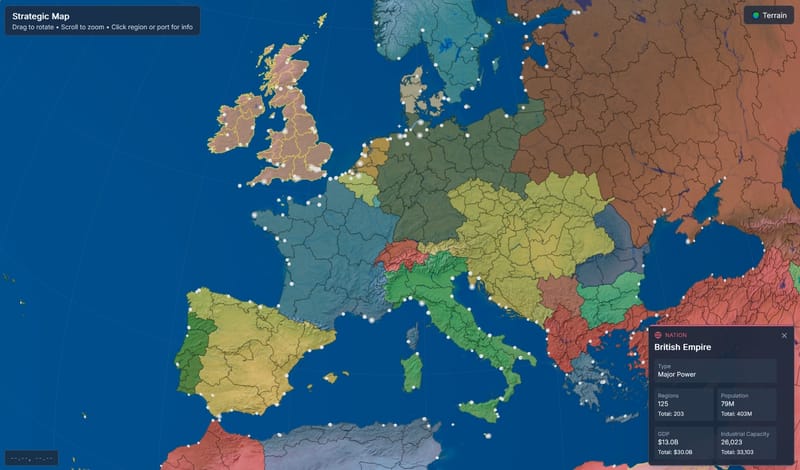
A handful of states possess the industry, money, dockyards, colonies, and political ambition required to build and maintain modern battle fleets. These are the powers whose decisions shape the naval balance of the new century. Their ships appear in foreign newspapers, influence diplomacy, alarm rivals, and consume vast sums from national budgets.
In Naval Estimates: The Dreadnought Age, eight major powers stand at the centre of this world: the United Kingdom, United States, Germany, France, Italy, Russia, Japan, and Austria-Hungary.
Each enters the century with different strengths, different anxieties, and a different idea of what sea power is for.
United Kingdom
The United Kingdom begins the century as the world’s leading naval power.
The Royal Navy is the shield of the British Empire. It protects trade routes, colonies, home waters, and imperial communications stretching across the globe. British security depends on the sea in a way few other countries can match. Food, commerce, troops, money, and political influence all move across the oceans.
Britain has enormous advantages. Its shipyards are among the best in the world. Its officers and crews have long experience. Its empire provides bases, coaling stations, and harbours across every major ocean. Its naval traditions are deep, and its political leaders understand that British power rests on maritime supremacy.
But supremacy is expensive.
Britain cannot focus on one sea alone. A new threat in the North Sea matters, but so do the Mediterranean, the Indian Ocean, the Pacific, the South Atlantic, and the long routes linking them. Every rival fleet is measured against the Royal Navy, and every new foreign battleship raises the question of how Britain should respond.
Britain does not begin the century by seeking naval greatness.
It begins by trying to keep it.
United States
The United States enters 1900 as a rising naval power.
The Spanish-American War has pushed the country further onto the world stage. The United States now has overseas interests in the Caribbean and the Pacific, and its leaders can no longer think only in terms of coastal defence. A country with new possessions, growing trade, and expanding industry needs a navy able to operate far from home.
American strength lies in its scale. Its industry is vast and still growing. Its resources are immense. Its geography offers security from most direct threats, allowing it to build power without the constant pressure felt by many European states.
But in 1900, American naval ambition is still taking shape. The United States must decide what kind of sea power it intends to become. A fleet for homeland defence is one thing. A fleet for the Caribbean and Pacific is another. A navy able to stand among the world’s great battle fleets is something larger still.
The United States begins the century with room to grow, and with the means to grow quickly.
Its future at sea is not yet fixed.

Germany
Germany is the great new challenger.
The German Empire is young, powerful, industrial, and ambitious. It has already become one of Europe’s dominant land powers. Now its leaders want a navy to match its status. Under Admiral Tirpitz, Germany begins to lay the foundations of a battle fleet intended to make the empire impossible to ignore at sea.
Germany’s position is promising, but dangerous.
Its industry is modern. Its administration is efficient. Its naval effort is concentrated close to home. Unlike Britain, Germany does not need to defend a vast maritime empire scattered across every ocean.
But Germany’s main naval theatre is the North Sea, and across that sea stands the Royal Navy.
Every German battleship is more than a warship. It is a political signal. A larger German fleet promises prestige, security, and diplomatic weight, but it also risks provoking the very rivalry it is meant to prepare for.
Germany enters the new century determined to be treated as a world power.
The cost of that ambition will be counted in steel, money, and suspicion.
France
France is an old naval power with difficult choices.
The French Navy has prestige, technical skill, and global responsibilities. France has colonies to defend, Mediterranean interests to protect, and a long tradition of naval thought. Its ship designers and naval officers are capable of bold ideas, and French warships often reflect a willingness to experiment.
But France’s strategic position is complicated.
Britain is no longer the only possible rival. Germany is rising. Italy matters in the Mediterranean. Overseas commitments require cruisers, bases, and ships able to operate far from home. At the same time, a great power is still expected to maintain a serious battle fleet.
French naval policy must balance many competing demands: battleships, cruisers, torpedo craft, commerce protection, colonial service, and coastal defence. Each has a claim on the budget. None can be ignored entirely.
France begins 1900 as a great power with many possible naval futures.
The difficulty is choosing which one to pursue.
Italy
Italy is a young kingdom with great-power ambitions.
Its geography points naturally toward the sea. The Italian peninsula reaches deep into the Mediterranean, surrounded by waters that are strategically vital and politically crowded. France, Austria-Hungary, Britain, and the Ottoman Empire all matter to Italian naval planning.
Italy has talented designers and a taste for ambitious warships. Speed, firepower, and modernity all have a strong appeal. Italian naval thinking is often energetic and imaginative.
But Italy’s resources are limited compared with the largest powers. Prestige must be paid for. A powerful fleet is desirable, but so are armies, infrastructure, industry, and the many other demands of a modern state.
Italy enters the century with the aspirations of a great naval power and the constraints of a smaller budget.
Its challenge is to turn ambition into ships that can actually be built, manned, and maintained.
Russia
Russia is vast, powerful, and geographically awkward.
Few countries possess such scale. Few face such difficult naval geography. Russia’s fleets are divided between separate theatres: the Baltic, the Black Sea, the Pacific, and the far north. These waters are separated by distance, diplomacy, ice, and chokepoints.
That division matters.
A ship in the Baltic cannot easily support the Pacific. A fleet in the Black Sea is constrained by the straits. A squadron in East Asia may find itself isolated in a crisis. Moving ships from one theatre to another can become an operation in itself.
Russia begins the century with imperial ambitions that stretch from Europe to the Far East. Its interests are wide, but its fleets are scattered. The coming conflict with Japan will show how dangerous that situation can become.
Russia does not lack ambition.
Its problem is turning size into usable naval power.
Japan
Japan is the rising naval power of East Asia.
In only a few decades, Japan has transformed itself from an isolated state into a modern empire. Its navy has grown with remarkable speed, helped by foreign expertise, domestic reform, and a clear sense of strategic purpose.
By 1900, Japan is no longer a peripheral concern. It is a serious power in East Asian politics, with interests in Korea, China, and the western Pacific. Russia’s growing presence in the Far East makes the naval balance especially urgent.
Japan’s position is sharply focused. Unlike the older European empires, it does not need to scatter its fleet across the world. Its main concerns lie close to home. That concentration gives Japan clarity, but not safety. Its rivals are larger, richer, and more established.
Japan enters the century as a new power in a dangerous sea.
It must be modern, decisive, and fast.

Austria-Hungary
Austria-Hungary is a great power with a narrow window to the sea.
Its navy is based in the Adriatic, a confined but important theatre. The empire does not possess a global maritime network like Britain or France. Its overseas interests are limited. Yet naval power still matters. It brings prestige, protects the coast, supports diplomacy, and checks regional rivals, especially Italy.
The Austro-Hungarian navy exists within tight limits. The empire’s politics are complex. The army demands attention. Naval spending must compete with many other priorities inside a state made up of many peoples and interests.
Austro-Hungarian sea power is therefore concentrated. It does not need to dominate the oceans to matter. In the Adriatic, even a smaller fleet can shape events.
Austria-Hungary enters 1900 as a continental empire with a maritime frontier.
Its navy is modest beside the fleets of the oceanic powers, but close to home it can still be decisive.
Continued in Nation Overview - Part 2: the minor powers.