About
Naval Estimates: The Dreadnought Age is a free naval grand strategy game about the ships themselves - how they are designed, argued over, paid for, built, and sent to sea. It begins in 1900, with the world's navies on the edge of the dreadnought revolution. The front page makes four promises - design the ships, build the fleet, balance the budget, face the consequences - and this page is what they mean.
Design the ships
Most strategy games treat a warship as a unit. Here, a ship is the sum of decisions you made years earlier - made in three workshops, each feeding the next.
Forge the guns
Design starts with the gun: calibre, barrel length, construction, propellant, shell and charge, each choice feeding a ballistics model that produces real muzzle velocities, barrel life, and armour penetration by range. A finished gun becomes a saved design - a 12"/45 Mark X your navy can manufacture, improve, and build into mountings.
Assemble the turrets
Guns then need mounting. The turret designer wraps them in armour and machinery: mount type, drive, loading system and angle, magazines and ready racks, every choice playing out in traverse and elevation rates, rate of fire, crew, and weight. A turret is an engineered object in its own right - and its weight, cost, and barbette diameter are inherited by every ship that carries it.
Draft the hulls
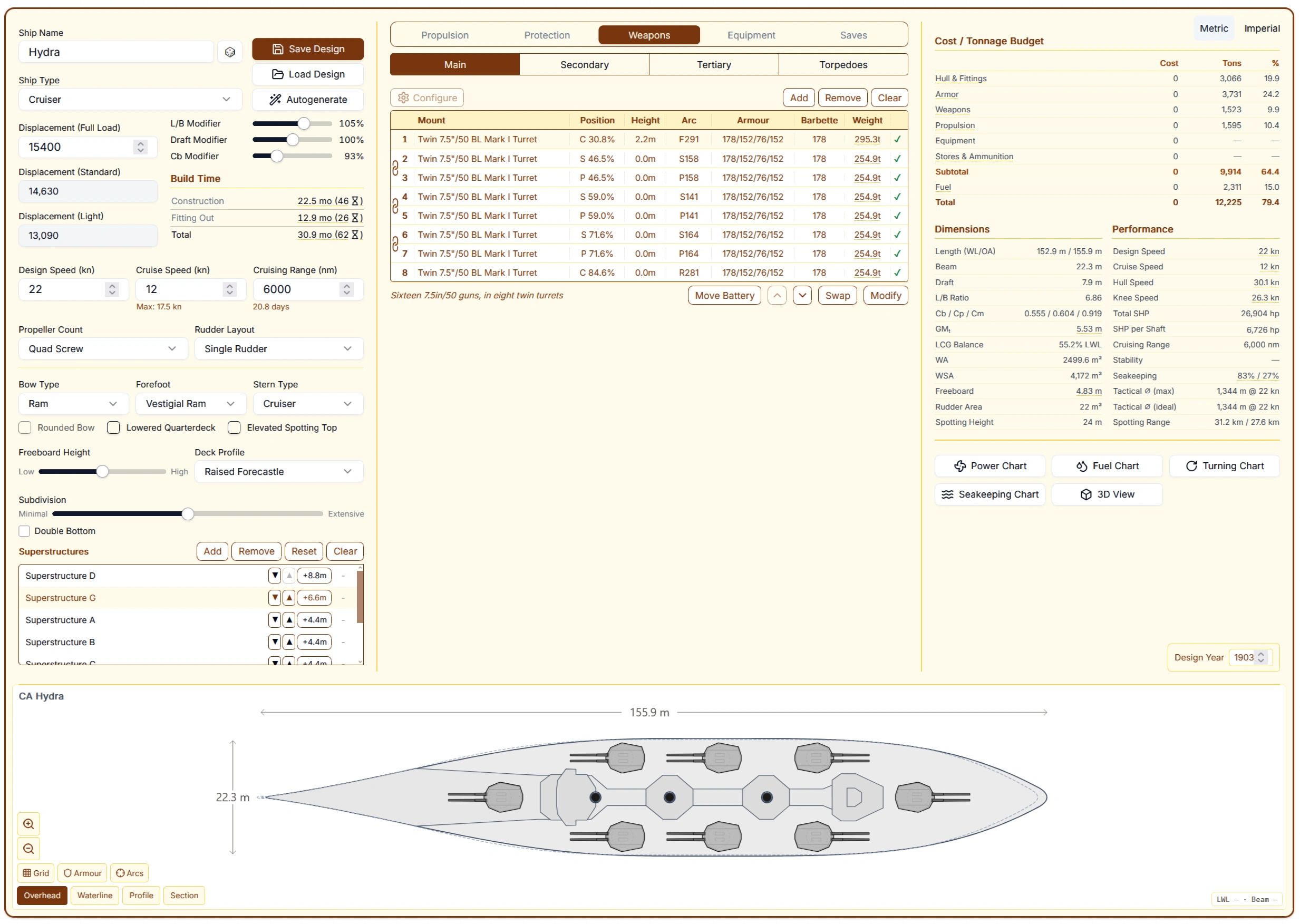
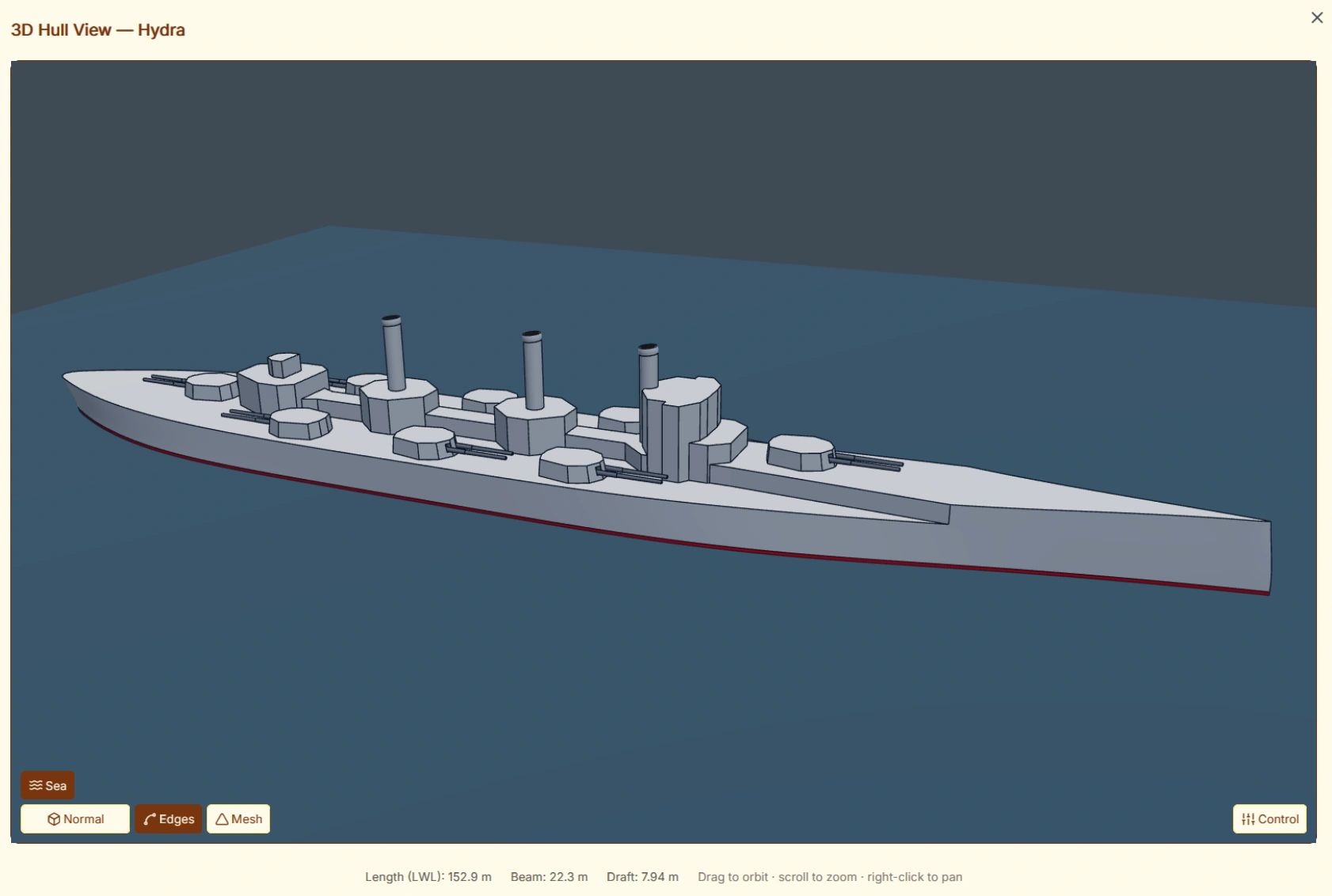
Last comes the ship itself, drawn as a real object: hull form and freeboard, machinery and boiler rooms, subdivision, superstructure, armament layout and firing arcs, armour scheme - all balanced against displacement, stability, and the budget. The designer works in real hydrostatics, so a fast, well-armed, well-protected ship on a small displacement is just as impossible as it was for the real design boards.
Improve the gun, and the improvement cascades up through every mounting and ship that uses it. The result is a navy with a paper trail: every class in your fleet can be traced back through the decisions - and compromises - that produced it.
These three workshops - gun, turret, hull - are the whole of the first free public build: the foundation, playable first.
Build the fleet
A design on paper is one thing. A fleet is an industrial act, and designs live lives of their own: a gun moves from concept to drawing board to tooled production line to service in the fleet, and each step deepens the commitment. Tooling makes a design cheaper to build and more expensive to abandon; a weapon in service brings spares, training, and refits along with it. When something better comes along, you choose - modify the old design and keep its tooling, copy it as the starting point for something cleaner, or start fresh and pay for it. Your navy inherits designs, tooling, and compromises.
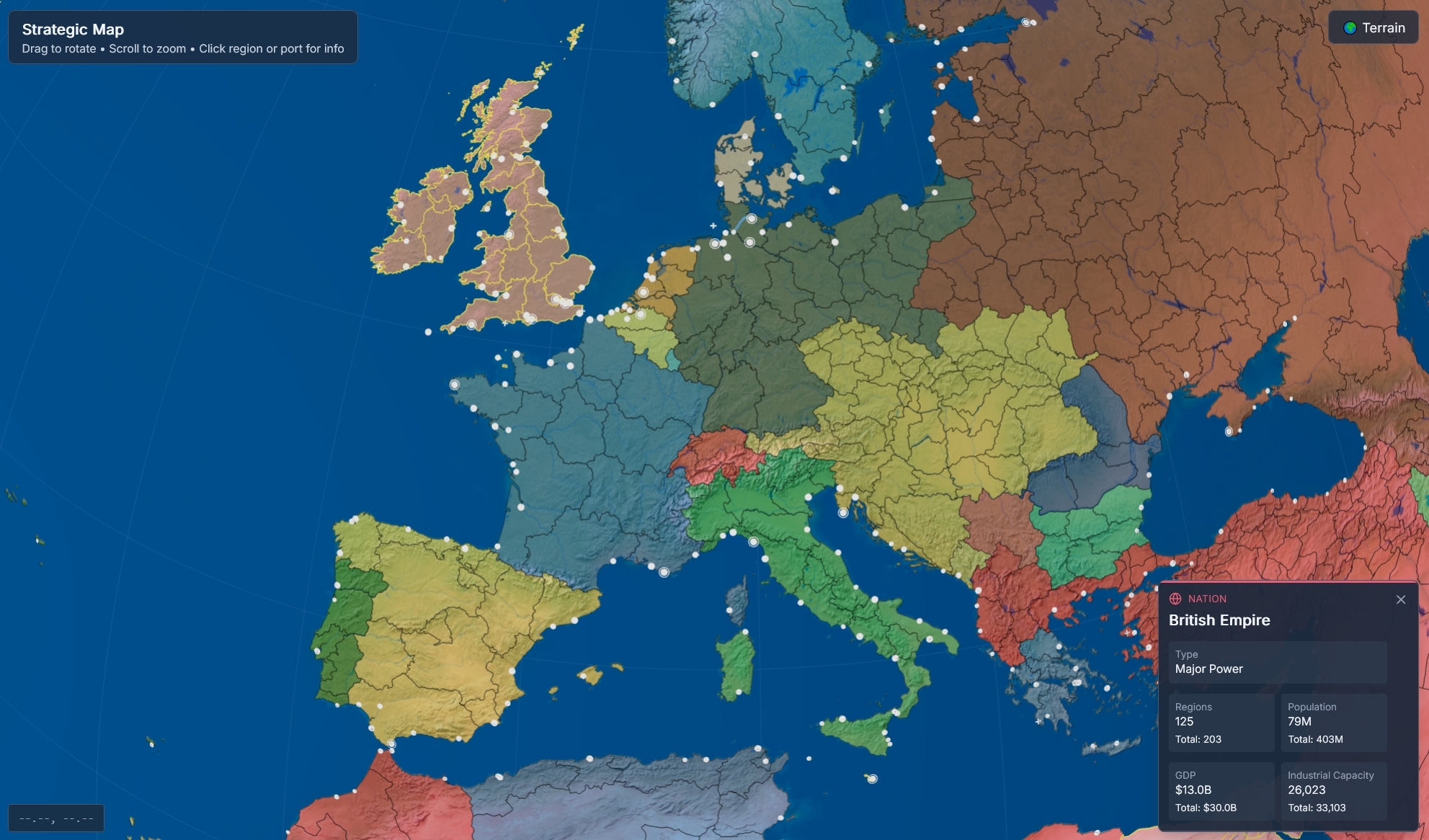
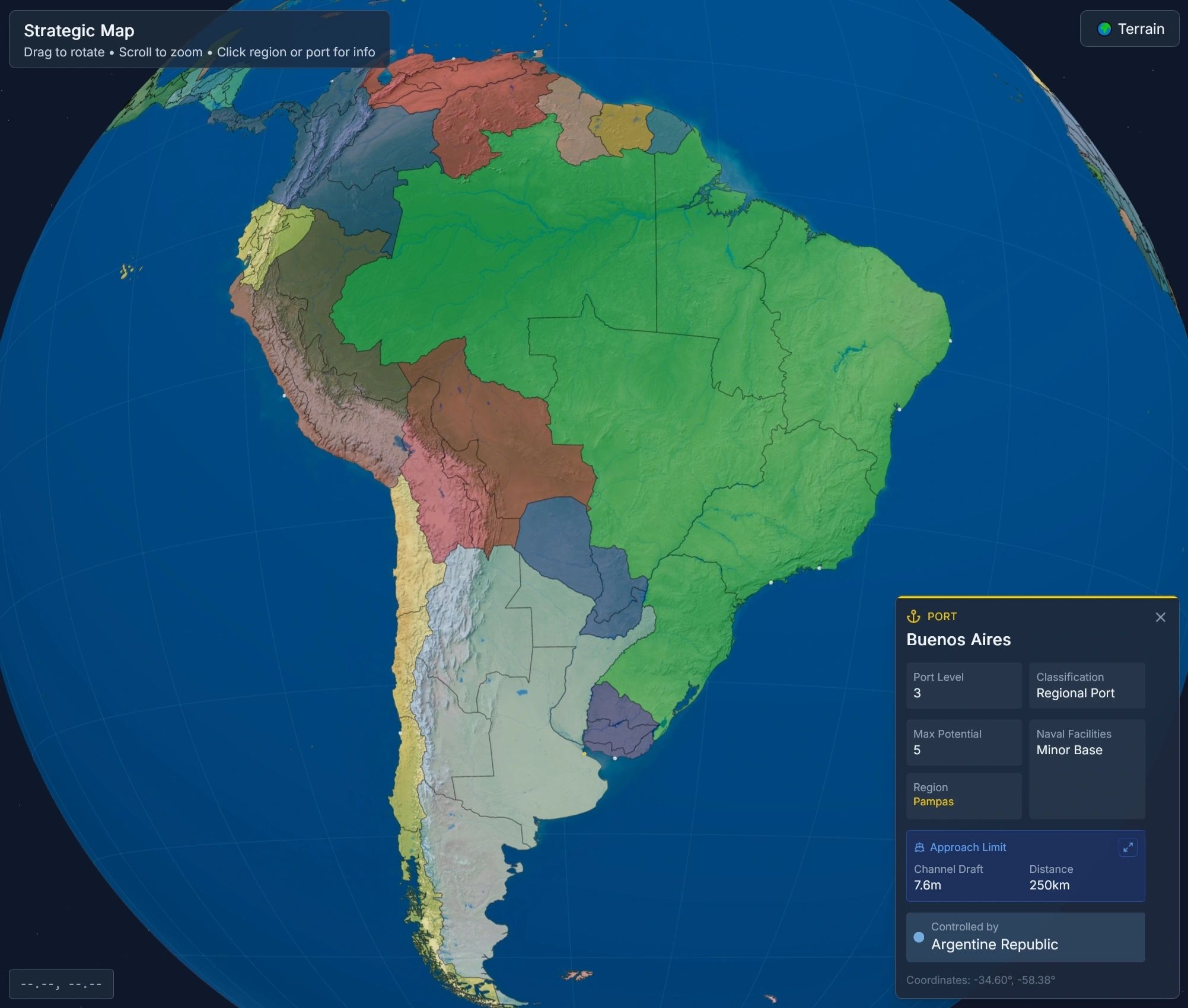
And every fleet is built for its seas. The game opens in 1900 with seventeen playable nations - eight major naval powers and nine minors, each with its own fleet, budget, geography, and problems. The Kiel Canal carries the real canal's transit limits, and a battleship designed a metre too broad for it is a strategic problem - exactly as it was for the Kaiser's navy. For a tour of the setting, start with Setting the Scene and the nation overviews on the blog.
Balance the budget
The name comes from the real thing. The Naval Estimates were the annual statement of what a navy would cost, laid before a parliament for approval - most famously the Royal Navy's, presented to the House of Commons each year by the Admiralty. Every battleship began its life not on a slipway but as a line in a budget, debated by politicians weighing the fleet against everything else a nation wanted.
Those debates could decide the fate of navies, and occasionally of governments. The dreadnought race turned the Estimates into front-page politics - the 1909 crisis over how many battleships Britain should fund produced the cry "We want eight, and we won't wait", and Parliament got its eight.
That is the game's thesis: sea power was won in committee rooms as much as at sea. Naval Estimates puts you in charge of the whole process - the budget, the design board, the shipyard, the fleet.
Face the consequences
The game simulates the pressures of the period, not its outcomes. The world starts historical and then goes where decisions take it - an arms race answered, a budget rejected, a rival's new class making yours obsolete on the slipway.
And nothing shapes a navy like its own choices. The gun you tooled in 1903 is still arming your cruisers a decade later; the cheap machinery is still breaking down; the battleship you rushed is the one your admirals must fight with. Every fleet is the sum of its compromises, and you will live with yours.
Who's building this
I'm Elouda, and Naval Estimates is my passion project - the game I have wanted to play for most of my life.
Decades absorbed in naval history and warship engineering led here, through the hobby's deep end - designing warships in SpringSharp, fighting fleet actions under miniatures rules like Seekrieg, reading the armour and ballistics research of experts like Nathan Okun - and through modding the games that came closest, Hearts of Iron, Rule the Waves, War in the Pacific, War At Sea amongst them. All of it chasing the same thing: a game that takes the design board and the budget as seriously as the battle. In the end, the only way to play it was to build it.
You can reach me at contact@navalestimates.com, or find me on the Discord as Elouda.
Where it stands
Development began in December 2025. The first free public build is planned for July 2026: the complete design suite - guns, turrets, and ships - set in 1905, designing the Royal Navy's first dreadnought. The strategic layer is in development alongside it, and tactical combat is planned beyond that.
That order is deliberate. The design systems are the game's foundation, and putting them in players' hands early - before the war is built around them - means the community's designs, feedback, and arguments shape what the game becomes. The invitation is not to wishlist and wait: play, test, share designs, report problems, and help shape the simulation as it grows.