
Build 1.3.0
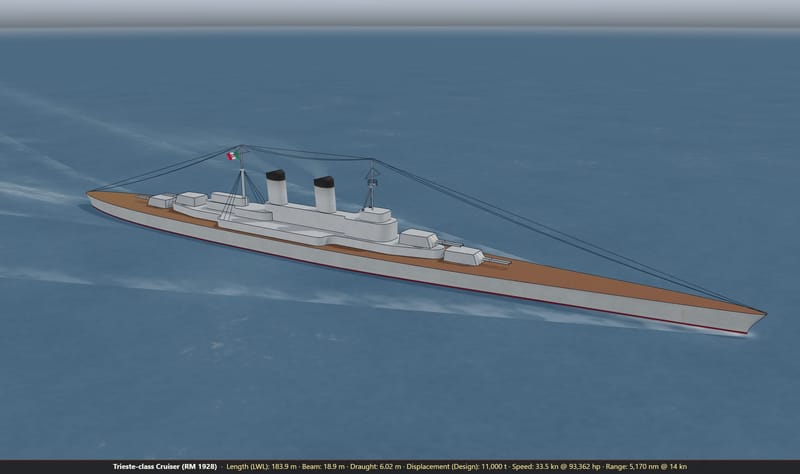
Build 1.3.0 is out. France and Italy join the nation roster, along with a 1928 start date - the latest that will be added for a while.
Torpedoes arrive, as deck-mounted tubes and as fixed internal rooms, both above and below water. Alongside them comes a large rework of hull forms, deck flare and sheer, and of machinery weights and power curves. Turrets now carry dispersion effects: guns and mounts both show the impact of dispersion and danger space, and the 3D penetration test gains a salvo mode that makes it visible. There is a good dose of quality-of-life work too - line snap, angle snaps, rounding, bow-right plan views - and a hefty round of bug fixes.
Every previous campaign save, design, gun code, mount code and design file should load. Saved ships, guns and turrets recalculate on load, though, and some may need adjusting before they are valid again.
This is more re-derivation on load than any release since 1.0. Every saved ship’s speed, horsepower, endurance, machinery weight, cost and stability readouts move to the recalibrated physics; hulls redraw on the new planform and sheer laws; saved turrets take a drive type and recalculate their heights and pits; every gun and mount’s accuracy and barrel life move; and magazines, belts and mount placements re-check under the new laws.
Additions
- France and Italy are playable, and 1928 is available as a start date
- Torpedo armament: deck mounts and fixed internal tubes
- Turret drive types reworked - Manual, Ring Hydraulic, Electric and Electro-Hydraulic, each with its own weight, cost and training speed, plus a Reserve Drive option, and ships with ring mounts carry the plant that powers them
- Per-mount Accuracy: the turret designer scores each mount’s shot pattern from barrel spacing, gun count, drive and ring balance, and the range tables gain a Danger Space and Pattern display showing fall of shot against a target
- Internal mounts: an open pedestal can sit inside the hull or a superstructure and fire through a bare gun port
- Salvo mode in the 3D viewer: fire up to 20 shells from any saved gun, mount or pasted share code at your ship, scattered by its real dispersion, with splashes, ranked results and click-selectable shell traces
- Textured surfaces in the 3D viewer: period riveted or welded plating at true scale on hull, superstructure, decks, masts, funnels and mounts, a Rust slider, improved masts with railings and fittings, funnel soot and caps, and an optional black funnel band
- Gun designer Auto-Optimise: pick a priority and the charge and chamber tune themselves, leaving everything else as set
- Gun bore entry in either unit - click or scroll the millimetre or the inch figure, both always visible and in sync
- Enter Dimensions in the ship designer: type length, beam and draught, and the hull sliders solve to the closest buildable match at that displacement
- An elliptical stern, the classic pre-dreadnought and early-dreadnought shape, joins the stern options
- Belt slope and lower-belt shape are researched: a steeper external belt unlocks with Armour Development, and the lower belt’s taper and depth presets each have their own technology requirements
- Armour thickness cells stop at the material floor, then re-pick the plate - scrolling past a face-hardened minimum swaps to the best plate that can take the thinner gauge
- 2D designer precision tools: arrow keys nudge any selection in 1 cm, 10 cm or 1 m steps, superstructure points snap to nearby edges or fixed bearings (held from whichever neighbour is nearer), a straight edge can be rounded into a curve, and an angle readout shows each edge’s bearing
- Ten save slots with compressed storage, optional campaign names at creation, and a pencil rename in the save list
- Bow-right plan views: the 2D overhead, waterline and profile views draw bow-on-right
- The Summarize card quotes the belt’s angle and its depth, and the Protection rows show the drawn angle of the upper and extended belts
Fixes
- Placing items in the 2D plan view landed off the cursor at any UI scale other than 100%; clicks now land where you click
- Overlapping gunhouses could pass unflagged - a superfiring mount close in height to the one below could sweep its arc into that mount’s roof, and a forward mount just under a deck sheer could swing its muzzle into the mount behind. Both now flag, or raise automatically under Auto heights; this may be too aggressive at the moment, and is under review
- A mast leg passing through a funnel went unflagged
- A half-typed displacement could permanently drop a top-deck superstructure a deck down
- Mast placement and leg drags could not be undone; they join the undo list, and Ctrl+Y now redoes alongside Ctrl+Shift+Z
- Modifying one of a pair of mounts dropped its partner, height, facing and barbette armour choices; swap and modify now carry the pair together
- Superstructures placed flush or crossing at an angle drew distorted walls in 3D
- A forecastle or quarterdeck break dragged past amidships moved the belt and armoured deck with it
- A casemate battery cut into a deck set inboard of the hull side showed no armour strake in 3D
- 3D belt strakes left gaps and phantom plating, and belts split near the waterline at bow and stern; they now follow the hull exactly
- The turtleback deck clipped an internal belt
- The Propulsion panel misnamed plants
- Reboring a gun could raise a false shipyard-infrastructure warning when the barrel’s length had not changed
- Removing or fitting a gun liner left a long-decimal pressure limit; limits round to the whole MPa
- Paired mast legs drew behind funnels they pass in the profile view
- A covered casemate falsely blocked a mast foot standing on the plating above it
- 1920 save slots carried the 1905 imperial names instead of the campaign date’s own identities - the Weimar Republic, the Russian SFSR
- Weight tooltips hid some items, and the resistance tooltip’s components did not sum to its total
- The 3D sky showed a band of flat backdrop between the sea’s rim and the horizon from a high camera
- The ring-balance counterweight was priced as worked gunhouse structure; it now prices as cast ballast
- Several number fields fought the keyboard: ready-rack counts, the gun designer’s belt slope, the gun picker’s design-year fields, and a half-typed speed
Balance
- Ship physics recalibrated against historical records. Every saved ship’s readouts move on load, by tens of percent of horsepower in some eras and by metres of GM on capitals
- Hull shapes drawn from traced references, the hull side above an angled belt follows the armour plane, destroyer hulls no longer read too fine at the waterline, and the deck sheer rises steepest at the stem; saved designs redraw on load
- Armour extension presets are equal rungs from the same base at bow and stern
- The dispersion scale is re-anchored, pressure penalties now begin at 70% of the limit, and long barrels flex less
- Barrel life adjusted slightly across the board, autofrettage and liners are cheaper, and wire-wound guns keep more pressure margin
- Turret pit depth, gunhouse height and trunnion position derive from the drawn gun’s real recoil, so a small charge change no longer moves a saved pit by a metre; every saved mount recalculates its heights, weight, cost and build time on load
- The turret’s Internal Margin dial moves structure and armour rather than the gun pit or the machinery, a modified or refit mount shows the true volume and rate-of-fire penalty for how cramped it is, and the ring-balance counterweight may take up to 10% of the rotating mass
- Magazines stow a little looser, the cooling plant adds weight, and a magazine reaching below the underwater hull at the ends is now an error
- Deck-slope pockets charge internal volume and crew space, and wing coal stows into them
- Funnels sit closer, and mounts and hoists can sit closer to funnels, while a mast bisecting a funnel now reports an error
- Centre engine rooms drive the centre shafts on three- and four-shaft ships
Other
- The penetration display follows the shell’s whole path: break-up against overmatching plate, fuze arming and delay with duds, HE contact bursts, shells that skip or dive and can strike from underwater, and hits on turret floors, barrels, masts and equipment
- Mast paint defaults to Inherit, following the superstructure scheme like the funnel
- A mast-turret collision marks both items with the red cross
- Crew space reads to one decimal in metric
Six navies, four start dates, and torpedoes to argue about: the Discord is the place for all of it.