This Is My Naval Rifle
How Naval Estimates turns a naval gun into a design with history.
There are many 12-inch guns.
This one is yours.
In many naval games, a “12-inch gun” is a generic item. It has a calibre, maybe a range, a damage value, a penetration value and perhaps a reload time. It may have a quality or tier of some kind associated with it. It exists because the technology has been unlocked, and it disappears when a better number becomes available.
In Naval Estimates, a gun is not just a calibre. It is a design.
It has a barrel, a shell, a charge, a pressure curve, a muzzle velocity, a barrel life, a manufacturing cost, a tooling history, and eventually a service record. It begins as a concept, becomes a designed weapon, is tooled for production, enters service, and then remains part of your navy’s inheritance for years.
A gun can be modified. It can be rebored. It can be copied. It can be improved, stretched, modernised, or reluctantly kept because the tooling already exists and the fleet needs ships now.
That is the point of the gun designer.
Naval Estimates is not asking only: “What is the biggest gun you can mount?”
It is asking:
What kind of gun does your navy know how to build, what does it cost to improve it, and what consequences follow when you make it the heart of a new class of ships?
(Updated 21 July 2026: two small bugs in the gun model were caught after publication - overall length was adding the chamber on top of the barrel instead of counting it within, and the Mark X was labelled built-up when it is wire-wound. The figures and charts below are the corrected ones.)
A gun is more than its calibre
The easy way to describe a naval gun is by calibre - 12-inch, 9.2-inch, 6-inch - and most games stop there.
But calibre only tells you the diameter of the hole. A 12-inch/40 and a 12-inch/45 may fire the same shell, but they can be very different weapons. Those extra five calibres of barrel buy you velocity, but they also change the weight, the balance, the pressure behaviour, the barrel wear, the production cost, and the turret you’ll need to carry the thing.
So the designer tracks the lot:
- calibre,
- barrel length,
- shell weight,
- charge weight,
- muzzle velocity,
- pressure,
- barrel life,
- rate of fire,
- gun weight,
- gun length,
- cost,
- design date,
- and service/design status.
That’s what lets two guns with the same number on the label feel like different weapons. A late-1890s 12-inch/40 is a perfectly respectable piece of kit: cheaper, shorter, lighter, and your navy already knows it inside out. The newer 12-inch/45 brings better velocity and penetration, but it costs more, weighs more, and starts making demands on your turret and ship designs.
“Which is better?” is the boring question. The interesting one is whether better is worth the delay, the cost, the tooling, and everything that follows.
The gun catalogue: your inherited arsenal
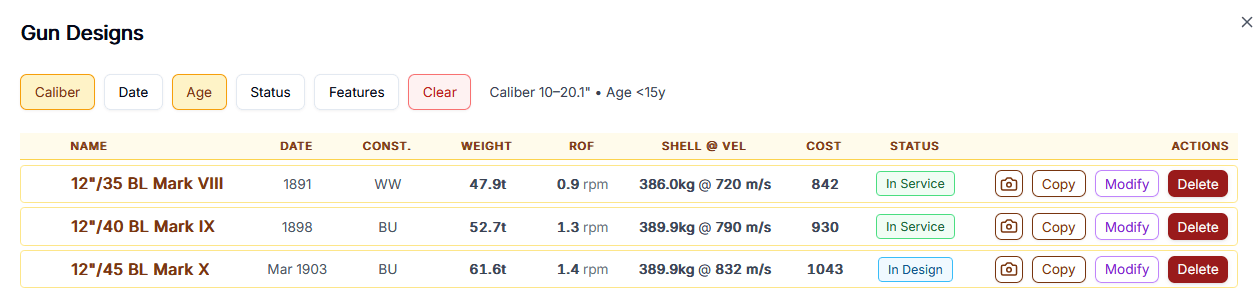
You don’t start with an empty list.
By 1900 a navy already has arsenals, factories, tooling, doctrines, and opinions: guns in service, older patterns still mounted on ships that aren’t going anywhere, newer designs working their way through the bureaucracy. You inherit all of it.
In the Royal Navy example, the catalogue above shows a small lineage of 12-inch guns:
- an older 12”/35 BL Mark VIII from 1891,
- a 12”/40 BL Mark IX from 1898,
- a newer 12”/45 BL Mark X entering design in 1903.
These aren’t just labels for flavour. Every design in that list has its own weight, rate of fire, shell, velocity, loading method, propellant, cost, construction type - and a status.
The status is the part to watch. An In Service gun is a known quantity: available, familiar, already in the fleet. A gun In Design might be better on paper, but it isn’t an industrial fact yet. It still has to be finished, tooled, and accepted.
So the catalogue isn’t a tech tree where old entries vanish when new ones unlock. It’s a living list you can copy from, modify, or rebore. A legacy gun may be:
- already in service,
- already tooled,
- compatible with existing mounts,
- familiar to crews and yards,
- technically inferior but strategically convenient.
Old designs stay relevant. Sometimes the best gun is the newest one. Sometimes it’s the one your yards can actually deliver in time.
That’s the moment this stops being a designer and starts being a procurement game.
The 12-inch/40 and the 12-inch/45
Here’s the clearest example: the 12-inch/40 BL Mark IX against the 12-inch/45 BL Mark X.
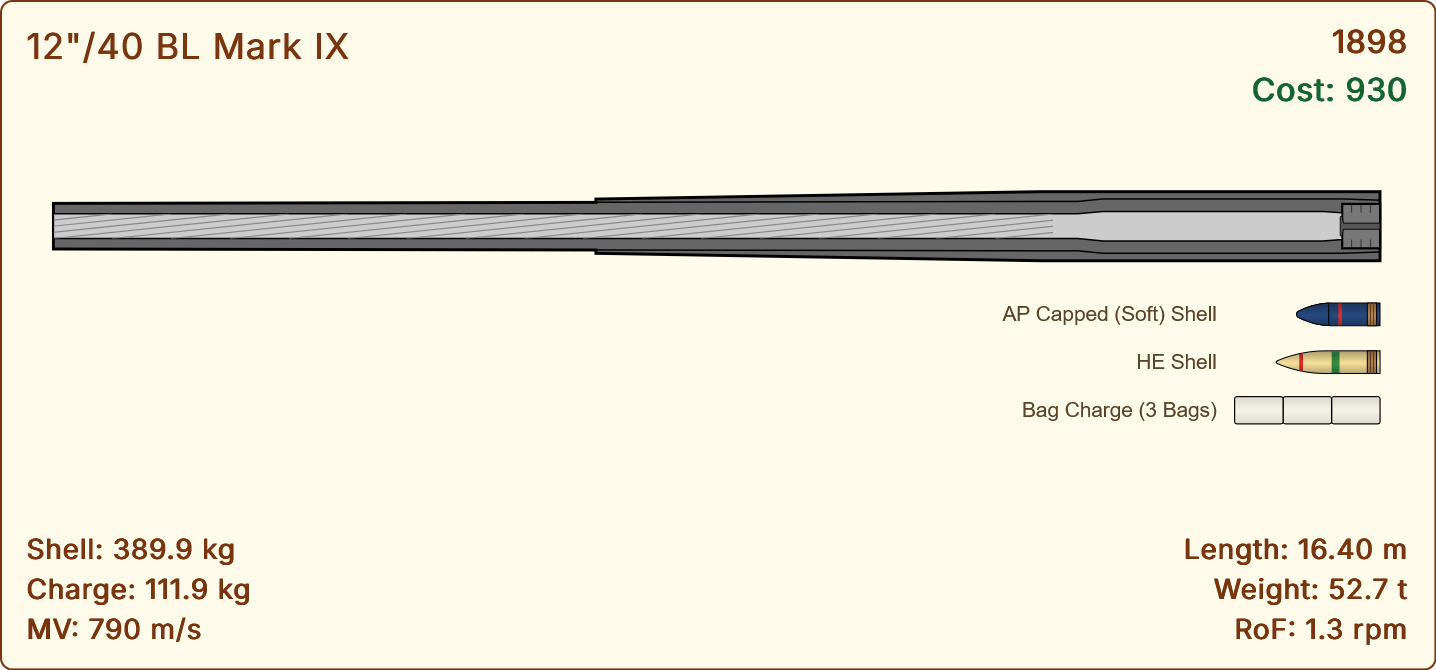
The Mark IX is the inherited world - shorter, lighter, cheaper, same shell at lower velocity.
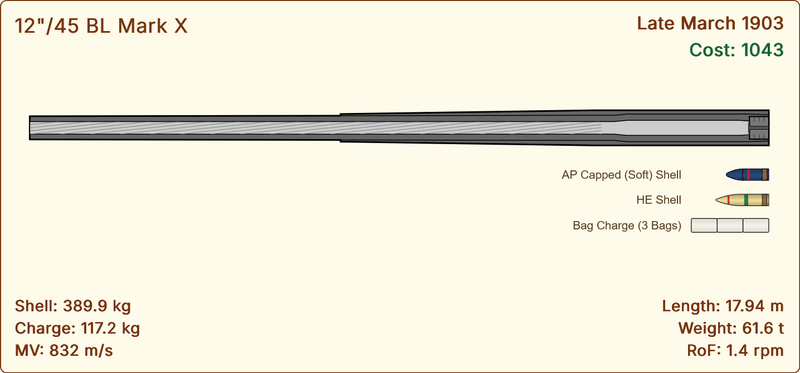
The Mark X is the newcomer - longer, heavier, pricier, faster shell.
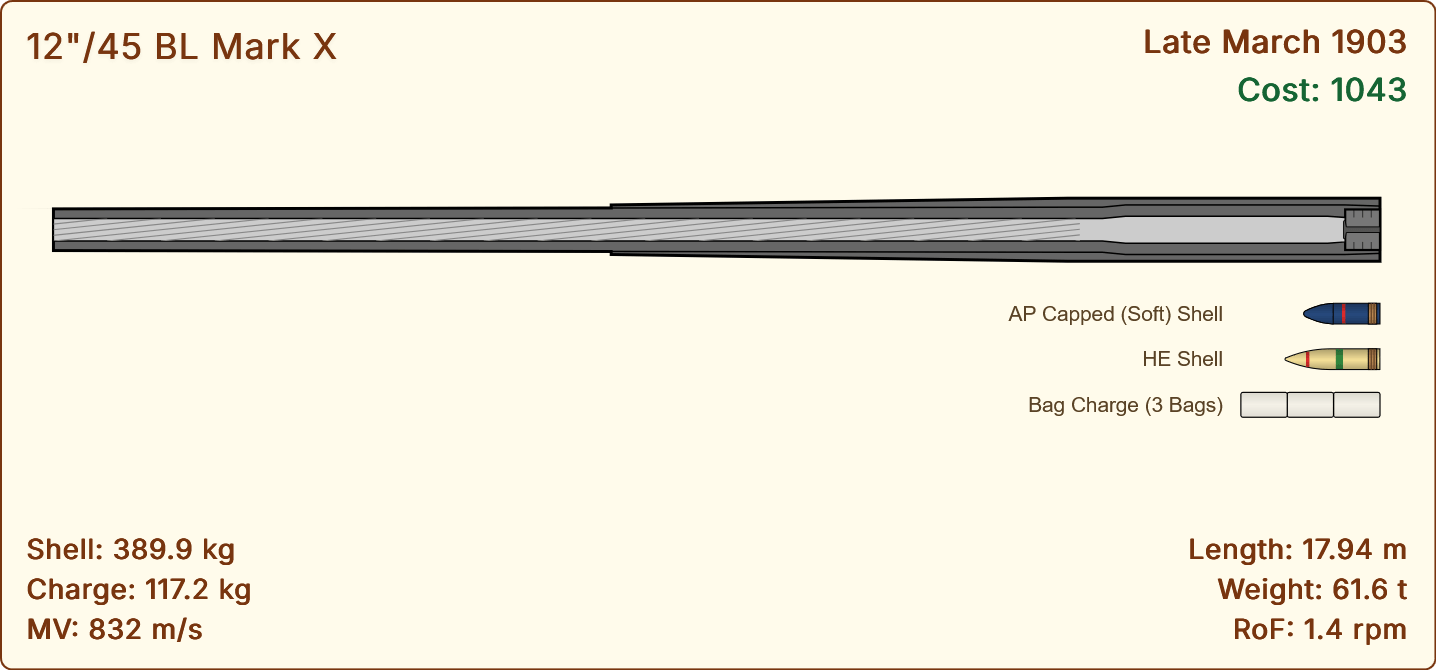
Side by side:
| Gun | Date | Shell | Charge | Muzzle Velocity | Length | Weight | Cost | Rate of Fire |
|---|---|---|---|---|---|---|---|---|
| 12-inch/40 BL Mark IX | 1898 | 389.9 kg | 114.8 kg | 789 m/s | 12.62 m | 52.8 t | 931 | 1.4 rpm |
| 12-inch/45 BL Mark X | Late March 1903 | 389.9 kg | 117.2 kg | 830 m/s | 14.13 m | 63.4 t | 1073 | 1.5 rpm |
On paper the Mark X wins easily. But none of it is free. It’s longer and heavier, so it probably wants a heavier turret. The heavier turret leans on the ship. The ship wants more displacement, more structure, more money - or sacrifices somewhere else.
That’s the chain the whole game is built around:
gun → turret → ship → construction programme → fleet consequences.
A gun is never just a gun.
Pressure: the violence inside the barrel
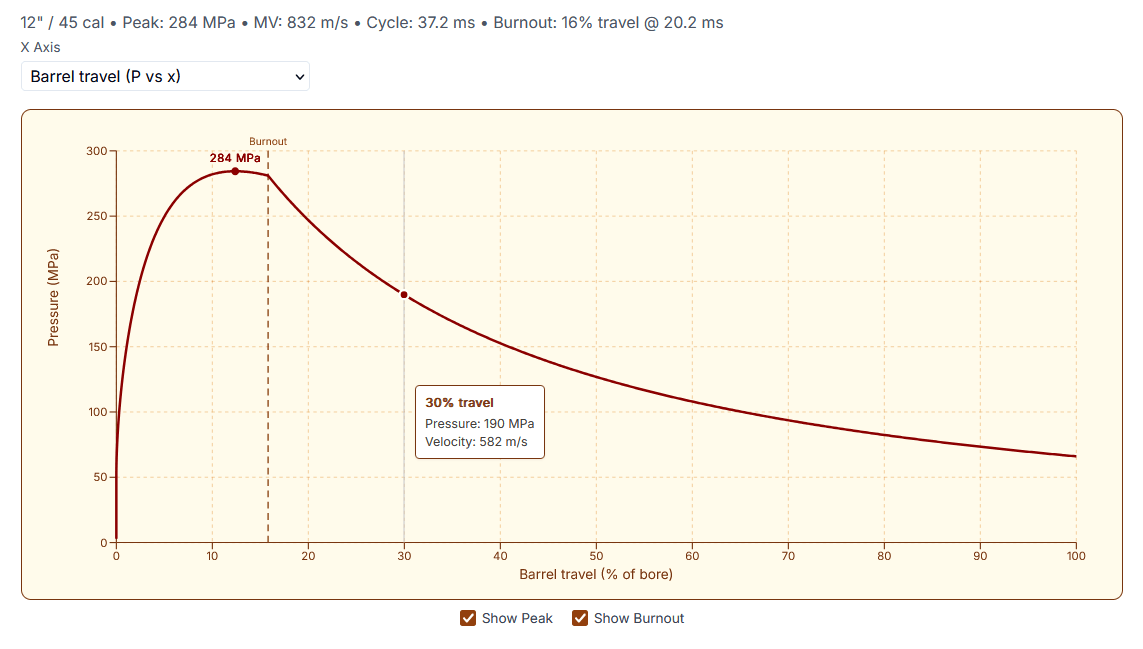
The designer includes an interior-ballistics view: chamber pressure through the firing cycle.
It’s not there because I expect anyone to do ballistics homework. It’s there because pressure is one of the hidden currencies of gun design. Velocity has to come from somewhere - a bigger charge, a longer barrel, a hotter design - and all of it shows up as pressure, stress, erosion, and cost somewhere down the line.
The curve makes that visible. In the example here, the 12-inch/45 peaks at around 303 MPa, and the shell leaves the muzzle at roughly 830 m/s. One look answers questions that would otherwise be buried in tables: where the peak is, how quickly it falls away, how much useful acceleration is left late in the barrel, and whether the design is conservative or being pushed hard.
You don’t have to calculate any of it yourself. But the model is exposed enough that the design feels physical.
Because a gun isn’t a number. It’s a controlled explosion inside a very expensive tube of steel.
Barrel life: performance has a service cost
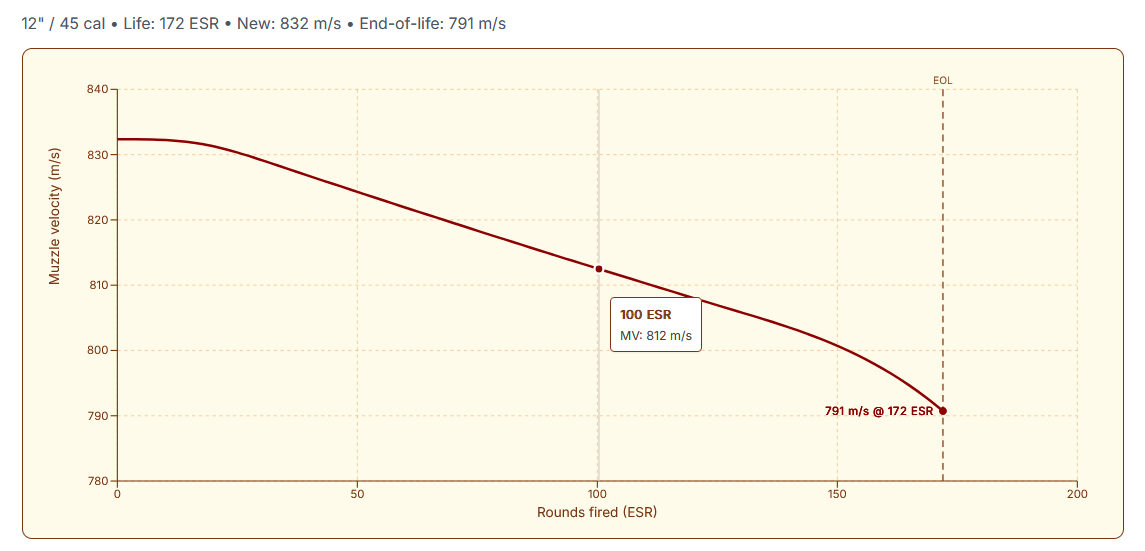
Guns don’t stay new.
Every shot erodes the bore, and as the bore wears, muzzle velocity drops - and with it accuracy and consistency. A monster gun that wears out in a hurry might be brilliant for one decisive afternoon and miserable to own for ten years.
So the designer charts it. The 12-inch/45 starts life at about 830 m/s; 161 equivalent service rounds later, the same gun manages only 789.
A navy isn’t buying one shot. It’s buying training, deployments, maintenance, relining, and - eventually - a war. A wealthy power might happily pay for peak performance and swap barrels more often. A smaller navy might take the gentler gun that keeps shooting straight on a budget.
Which is the real question:
Do you want the most powerful gun you can make, or the best gun your navy can afford to use?
Penetration: range changes the problem
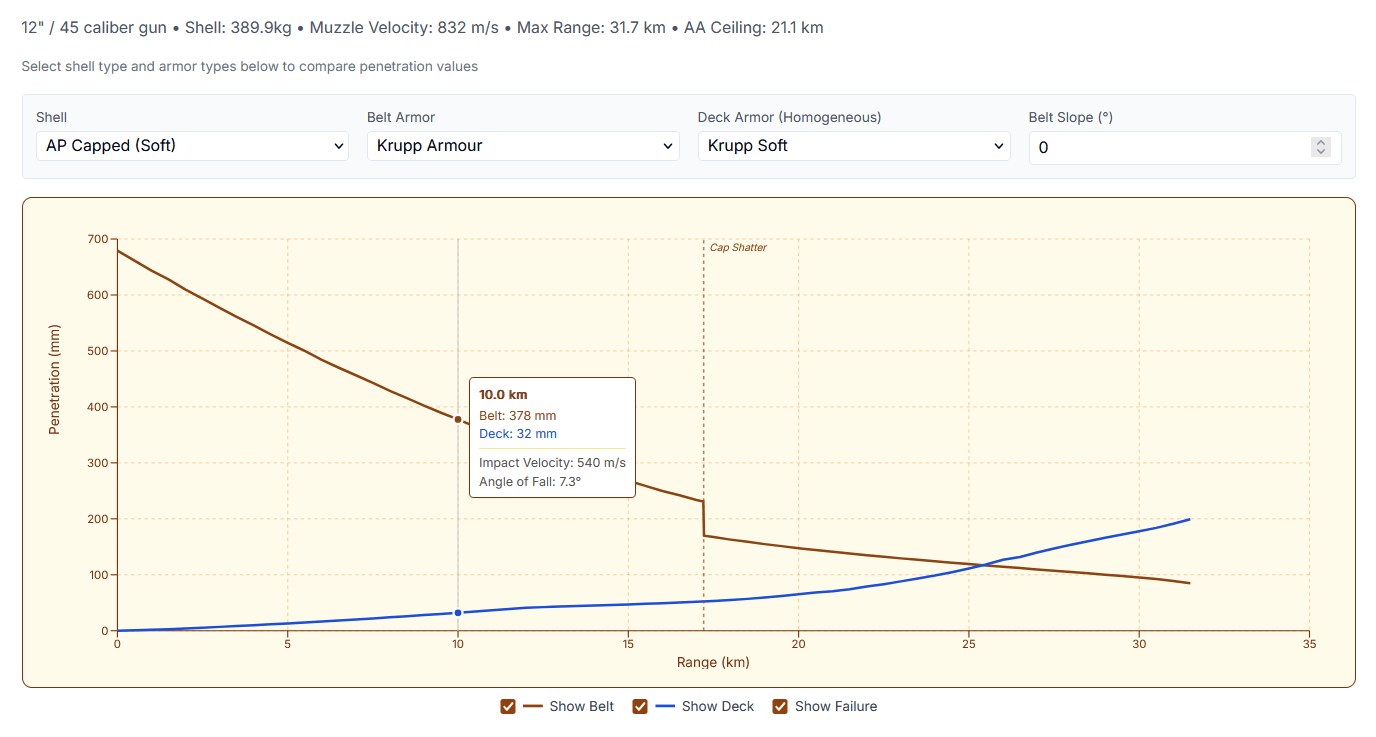
The penetration chart shows belt and deck penetration against range - because a naval gun doesn’t have one attack value. It has a relationship with armour that changes as the range opens.
Up close, it’s all about the belt: flat trajectory, high impact velocity, vertical armour. At distance the problem inverts. Velocity falls, the angle of fall steepens, and suddenly the enemy’s deck matters more than his belt. In the chart you can see the belt penetration falling, the deck line climbing to meet it, and a marked point where the shell’s cap starts to fail.
And you can play with all of it - shell types, belt and deck armour types, belt slope - and read off impact velocity and angle of fall at any range.
Which is, incidentally, one of the defining arguments of the dreadnought era: what counts as a “good” gun keeps changing as fire control improves and expected battle ranges stretch.
Conceptual, designed, tooled, in service
A design in Naval Estimates is always in some state of becoming. A weapon may be:
- Conceptual - a proposal or study, easy to change but not ready.
- Designed - a formalised design that can be evaluated and prepared.
- Tooled - an industrial commitment, ready to be produced.
- In service - an active part of the fleet’s equipment.
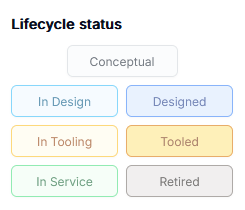
There are in-between states while design and tooling are underway, and retirement waiting at the far end of the ladder.
The states matter because design isn’t just engineering - it’s commitment. A concept costs nothing to abandon. A finished design has eaten time. A tooled design has eaten money and industrial capacity. An in-service weapon has eaten all of the above, plus training, spares, and doctrine.
Tooling is the big one. In Naval Estimates it isn’t a production discount - it’s what makes production possible at all: the gun pits, moulds, jigs, machining procedures, inspection instructions, drawings, and shop-floor knowledge that turn a design into actual weapons. You can evaluate, compare, and plan around a gun all you like. To build it, you tool it.
Which is why “the best gun” isn’t automatically the right gun. The new 12-inch/45 might be superior on paper while the old /40 is in service, understood, and already set up for production. That doesn’t make the older gun better. It makes the decision interesting.
Modify, rebore, or copy
Every design has a lineage, and when you’re working from an existing gun, there are three ways forward.
Modify
Keep the physical design and change what you can within it: new shells, altered charges, better propellant, small reliability work. Fast, cheap, often little or no retooling - and constrained, because you’re polishing the gun you have, not building the one you want.
Rebore or alter the chamber
The middle path. Open the bore out or rework the chamber and you can change more, while keeping the original tube and most of the physical design.
The catch is that the tube remembers. Bore it out and the walls get thinner, the safe pressure limit drops, and the new gun can’t be loaded as hard. A rebore can produce a genuinely useful intermediate weapon, but it isn’t a free upgrade - you can make something better out of what you already have, but you can’t escape what it was built from.
Copy
Start a fresh design from the old specification. Maximum freedom: new details, new production methods, new shells, propellants, or mountings. Real cost: new design time, probably new tooling, possibly disrupted production plans.
Quick and constrained, the middle road, or expensive and clean. That’s a real procurement decision, and the game is built to make you sit with it.
The gun is only the beginning
A gun doesn’t fight on its own. It has to be mounted.

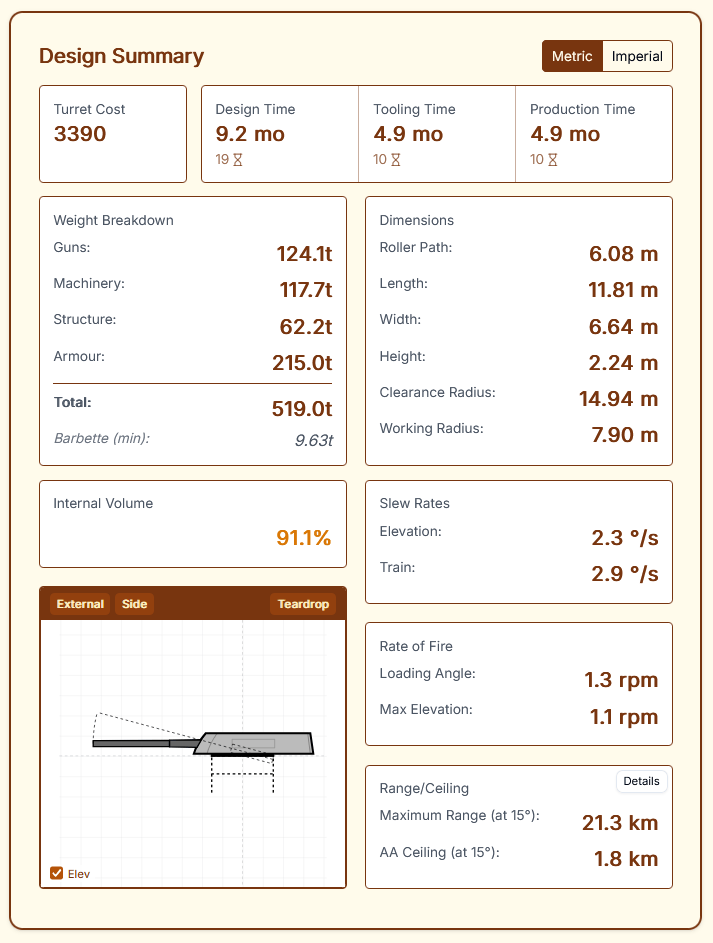
More gun means more turret: heavier machinery, a wider barbette, more armour to cover it all. More turret means more ship - layout, stability, cost, build time. Pull one thread and the whole design tugs back.
That’s why the gun designer is where the first public build starts. Not because designing impressive weapons is the point, but because this is where you can watch a decision propagate: more velocity means more barrel and charge, which means more weight and pressure, which costs barrel life and money, which demands a heavier turret, which forces a larger ship, which strains the budget, which means fewer ships.
That’s the chain that turns a technical choice into strategy.
The story of a gun
A gun in Naval Estimates can have a history.
It may begin as a conservative improvement to an older weapon. It may be rushed through design because the fleet needs a new battleship now. It may be tooled at great expense, forcing the navy to commit to it. It may later be modified with better shells or charges. It may be rebored into an intermediate pattern when money is tight or time is short. It may eventually become obsolete but remain in service on older ships. It may be remembered as a compromise, a triumph, or a costly mistake.
This is why the opening line matters:
There are many 12-inch guns. This one is yours.
The gun designer is not only a place to maximise numbers. It is where a navy’s technical personality begins to emerge.
Some navies will chase velocity. Some will value reliability. Some will standardise early. Some will keep modifying old weapons because the industrial path is already prepared. Some will gamble on a new design and reshape their fleet around it.
The gun is a weapon, but it is also a decision.
And in Naval Estimates, decisions have consequences.
Closing
The gun designer is one of the central systems of the first public build because it expresses the whole design philosophy of Naval Estimates.
A naval gun is not a generic component.
It is a technical object, an industrial commitment, a tactical promise, and a historical artefact in the making.
You design it. You tool it. You mount it. You build ships around it. You live with it.
There are many like it.
But this one is yours.