
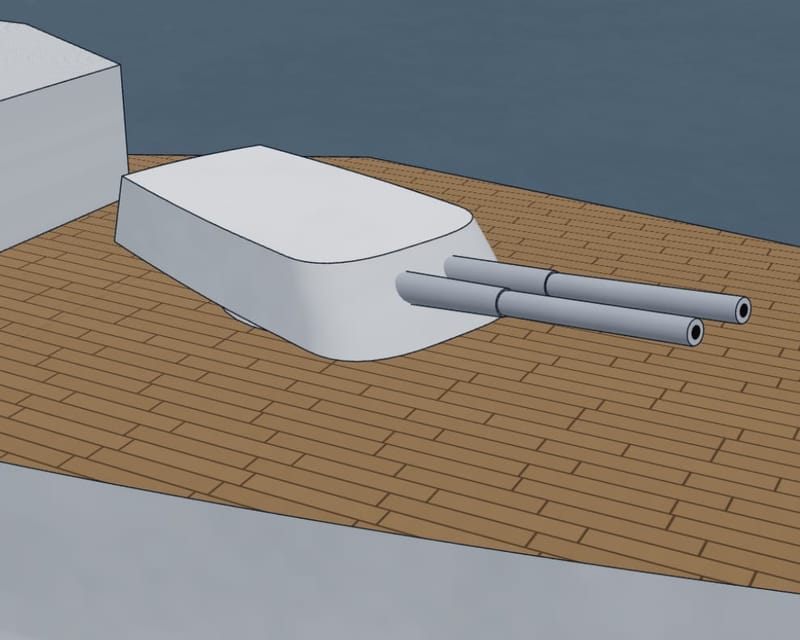
From Magazine to Muzzle
How Naval Estimates turns a finished gun into a working weapon - carried, aimed, and fed.
The Mark X is finished.
It is also, at this moment, useless.
Three years of drawing-board arguments, 63.4 tonnes of wire-wound steel, the finest heavy rifle your navy has ever built - and it is lying on trestles in a gun park, pointed at nothing, loaded by no one, wearing a tarpaulin.
Because a gun is not a weapon. A gun is a component.
It becomes a weapon when something carries it: turns it toward the enemy, holds it there through a turn at speed, feeds it a 390-kilogram shell every forty seconds, and keeps doing all of it while being hit. That something is the turret, and it is where most of the real decisions about your firepower get made.
In many naval games, the turret is a slot: guns go in, a rate of fire comes out. In Naval Estimates it is a machine you design, and the machine asks questions.
What can your ships actually carry, what does it cost to keep it fed, and what happens to your rate of fire when the answer is “not quite enough”?
(A note for the eagle-eyed comparing tables with last time: two small bugs were caught since the gun devlog - overall length was adding the chamber on top of the barrel instead of counting it within, and the Mark X was labelled built-up when it is wire-wound. Both nudge the figures slightly. The numbers in this post, and in the updated gun devlog, are the corrected ones.)
A house for the guns
Start with the machine itself.
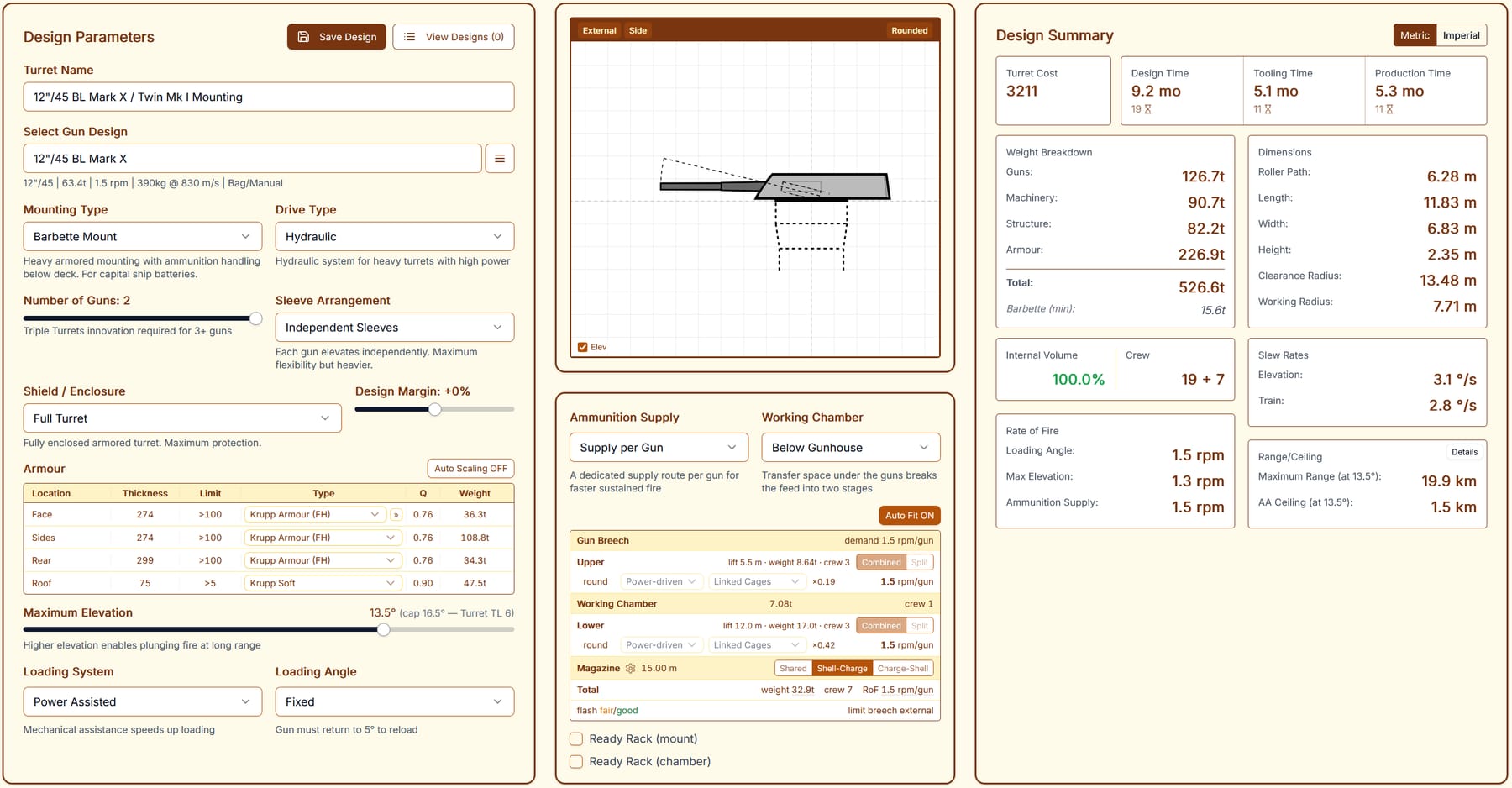
How many guns - and are two proven twins better than the triple your engineers swear they could manage? Do the guns share a sleeve and elevate together, or elevate independently at the price of extra weight? What drives the mount - steady, proven hydraulics, or the newer electric motors? Is it an open mount behind a shield, or a fully enclosed armoured turret? And the armour is not a number but a scheme: face, sides, rear, and roof, each plate with its own thickness and its own steel, drawn from whatever your metallurgists have most recently learned to make.
Then the quieter decisions, the ones that decide battles. Maximum elevation - higher reaches further, if your turret technology allows it. The loading system - hand-worked, or power rammers that never tire. And the loading angle: a fixed-angle mount must bring the guns back down to load, which is cheap, simple, and slow at long range, where every salvo means elevating all over again.
When you’re done, the designer prices your ambition:
- the weight - guns, machinery, structure, and armour, totalled,
- the roller path the ship must accommodate and the clearance its deck must give,
- how fast it trains and elevates,
- what it costs, and how many months to design, tool, and build,
- and the crew that serves it.
That last one is not a number but a muster list. A mount captain and a turret officer. Layers and a trainer. Sight setters, gun captains, breech workers, cradle and rammer operators, primermen, a sailor whose entire job title is “telephone number”, and the ammunition-supply hands working the hoists below. Twenty-six men, each with a named job, inside one rotating 527-tonne machine.
In 1903 there was almost nothing afloat or ashore more mechanically ambitious than a heavy gun mounting. Second place went only to the ship it sat in.
The guns are the light part
Here’s the first surprise: the guns are the light part.
Two Mark Xs together weigh 127 tonnes. The mount around them weighs 527 - the guns are barely a quarter of it. The training and elevating machinery alone comes to 91 tonnes, nearly matching them; the structure adds another 82; and the armour wrapped around the lot, 227 tonnes, outweighs the guns almost two to one.
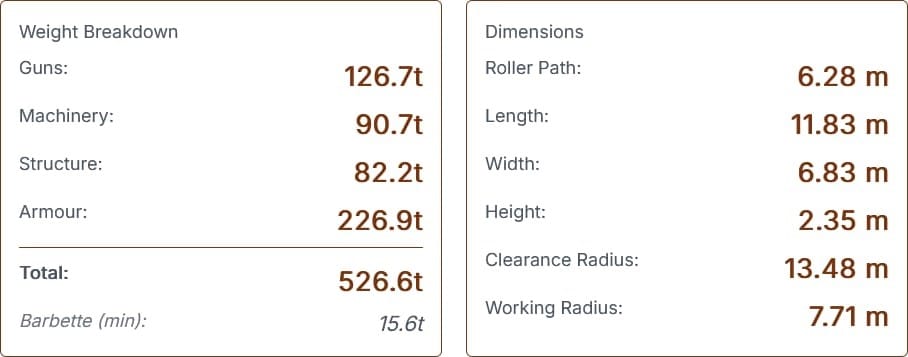
And the ship hasn’t even been designed yet - but this turret is already writing its requirements. Every hull that mounts it must build a barbette 6.3 metres across, armoured the whole way down. Every deck must clear its 13.5-metre swing. Every magazine must sit beneath it. A turret is a promise the ship will have to keep.
From magazine to muzzle
Now the new part - the reason this devlog has its name. In the build you’ll be playing, ammunition supply is designed, not assumed.
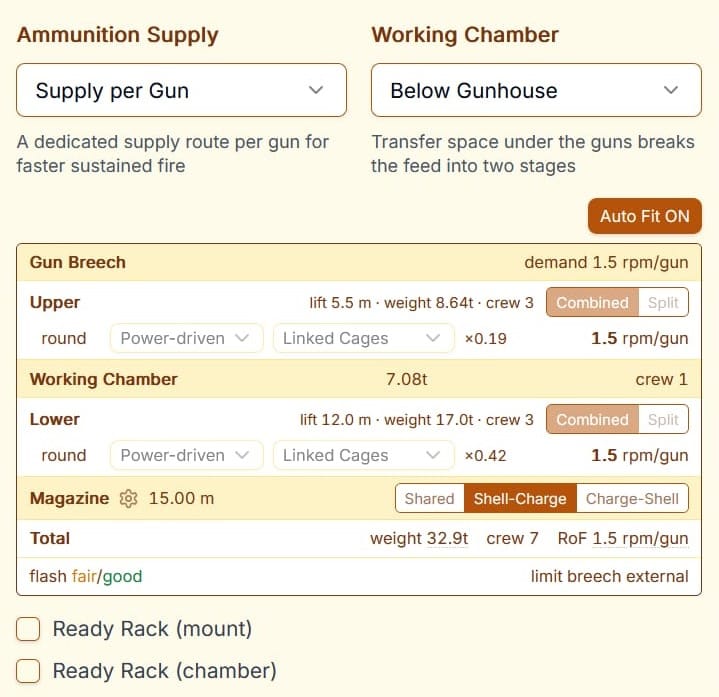
A 12-inch round begins its journey at the bottom of the ship, below the waterline, where it is safest: shells in the shell room, charges in the magazine - even their stacking order is yours to choose. From there, it has to climb.
One decision comes before any other: does each gun get its own supply route, or do the guns share one? A shared hoist is lighter, cheaper, and simpler to protect - and every round it lifts is a round only one of your guns can fire. At the light end this goes further still: a whole battery of small guns can live off a single hoist, with the difference made up by men - a human chain passing rounds from the central hoist to each mount, paid for in hands rather than machinery.
Then the climb itself, and here the designer offers a whole ladder of technology. At the bottom is muscle: rounds passed hand to hand, or heaved up on a hand-cranked hoist - cheap, dependable, and only ever as quick as tired men can be. Above that sits the cage hoist, a car that carries shell and charge up the trunk a load at a time - the workhorse of the dreadnought turret, faster than muscle but heavier, and hungry for the power to drive it. Higher still come the pusher and dredger hoists, which do away with the cage’s stop and start and send a continuous stream of rounds up the trunk: the quickest feed a turret can have, and the most demanding to build and to protect. Every rung up the ladder buys rate of fire and charges you weight, complexity, and money - nothing about the choice is free. And partway up, whatever the hoist, you can break the journey in a working chamber below the gunhouse: a transfer space that splits the feed into two stages, easier to protect, another thing to buy.
Then there’s the ammunition that waits at the top. Every mount holds a little of its supply forward-staged - the rounds in the guns themselves and the stock in the working chamber - and you can add more: ready racks at the mount or in a locker, rounds parked near the breech for a faster opening. The Mark X’s turret, you’ll notice, fits no racks at all. A heavy gun is a patient gun, and its hoists keep pace with its stately 1.5 rounds a minute without help. Ready racks are for guns in a hurry. More on those in a moment.
You don’t have to manage any of this shell by shell. But the model is exposed enough that the feed feels physical - and every one of these decisions is also a question about the day the turret is hit. Every rack, every open trunk, every shortcut between magazine and breech is a path flame can travel down as easily as shells travel up. The designer rates the whole arrangement for flash-tightness, and history has opinions about crews that traded it away for pace.
Which is the point of the whole system:
Your sustained rate of fire is not a number you pick. It is the output of a supply chain.
The guns set the burst - what the breech and rammers can cycle from the rounds staged close at hand. The chain sets the sustain - what the hoists can deliver, minute after minute, from four decks down. When the two match, as they do on this Mark X, the turret simply fires at its rate. When they don’t, the panel tells you which one wins, and how long the ready ammunition can hide the gap.
Years later: the refit
Here’s where it stops being a spreadsheet and becomes a story.
A decade on, the fleet wants more range. The answer looks simple: rebuild the Mark X mounts for 25 degrees of elevation instead of 13.5, and the same guns throw their shells 28.5 kilometres instead of 19.9. While the yard is at it, drop in the faster-firing Mark X* - 2 rounds a minute where the old gun managed 1.5. On paper, a better turret in every way.
But a refit happens inside a mount that already exists, and the designer greys out everything the hull has made permanent. The barbette is the diameter it always was. The magazines, the trunk, the hoists - the whole feed below the gunhouse - stay where 1903 put them. You can modernise the loading gear and the rammers inside the gunhouse; you cannot re-cut the ship around them.
So watch what actually happens. Raise the guns to 25 degrees and the gunhouse gets tighter around them: internal volume drops from 100% to 88.9%, and the panel warns, flatly, sustained rate of fire reduced. The faster gun now wants 2.1 rounds a minute; the old hoists, untouched, still deliver 1.5. With no ready racks, the only bridge is the round already staged in each gun and the one waiting in the working chamber - enough for about a hundred seconds at the new rate. Then the old feed takes over, and the turret settles back to exactly what it could do the day she commissioned: 1.5. You made the gun quicker, and the feed you could not reach handed the quickness straight back.
| Twin Mark X mount | As built | As refitted |
|---|---|---|
| Maximum elevation | 13.5° | 25° |
| Maximum range | 19.9 km | 28.5 km |
| Rate demanded | 1.5 rpm | 2.1 rpm |
| Rate sustained | 1.5 rpm | 1.5 rpm |
| Internal volume | 100% | 88.9% |
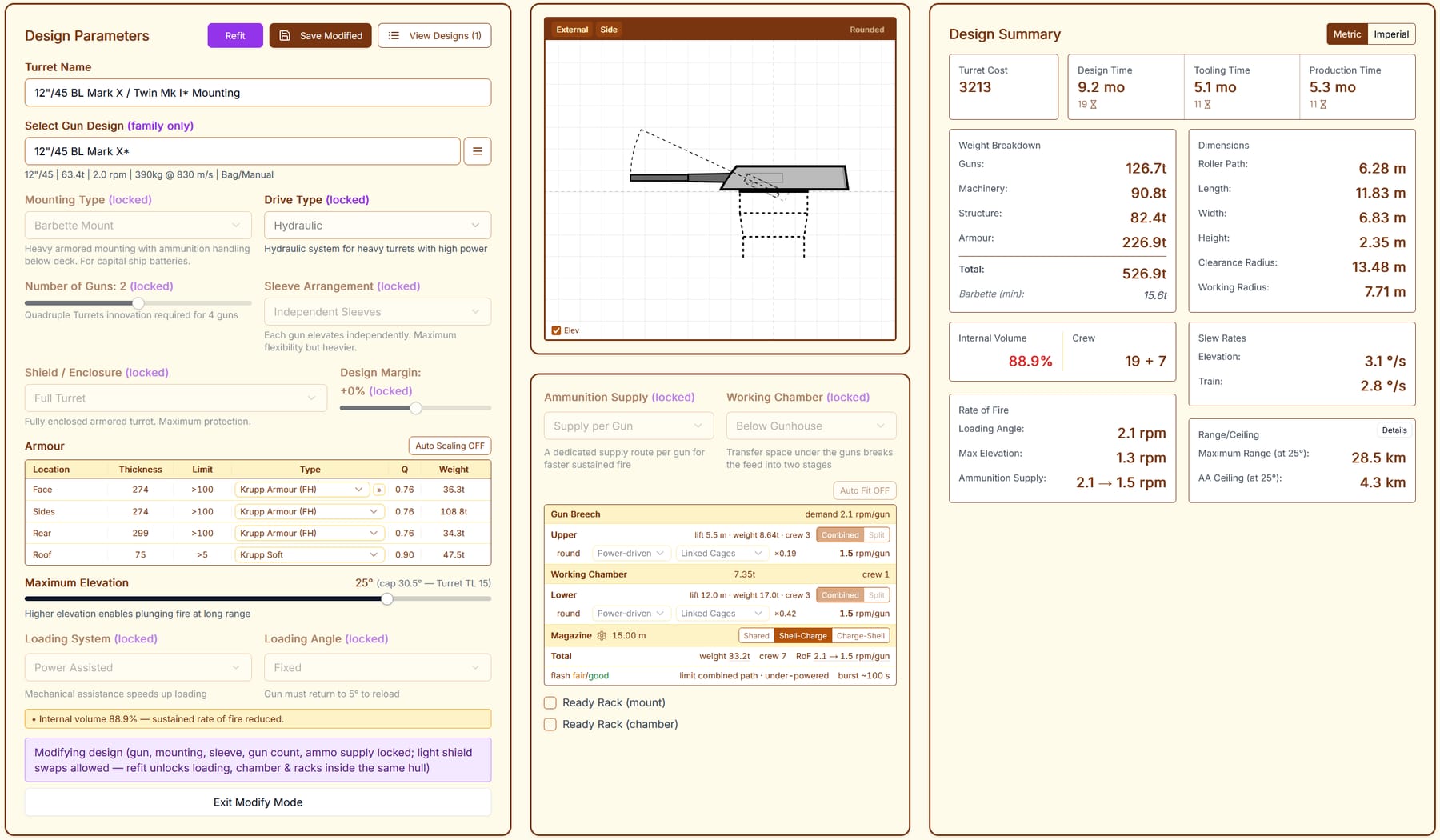
You bought range and elevation. You fitted a faster gun. And your sustained firepower did not move, because the one part you could not reach - the feed - was the part that set the ceiling.
Nothing malfunctioned. Nobody blundered. Every one of those numbers was the right answer to the question being asked at the time. That is what a fleet is: the sum of decisions that were correct once.
Guns in a hurry
Everything so far has moved at a heavyweight’s tempo - one round every forty seconds, hoists that keep up without trying. Now meet the 12-pounder: a three-inch quick-firer whose cased rounds are slammed home by hand at whatever angle the gun happens to sit, good for six rounds a minute - the kind bolted in batteries along a ship’s sides to throw up a wall of splashes against a charging torpedo boat.
Run the same arithmetic and it falls apart. There is no room for a stately barbette and a powered hoist under every little gun on the upper deck, so here one supply route serves a whole battery - four mounts, in this arrangement - and the last stretch is done by hand: a chain of sailors carrying rounds from the hoist head to each gun. The guns demand 5.9 rounds a minute apiece. The hands can sustain 2.0. Everything between those two numbers comes out of the ready ammunition staged around the battery - the chambered rounds, the deck lockers, the rack at the hoist head - and the designer traces it burning down, act by act:
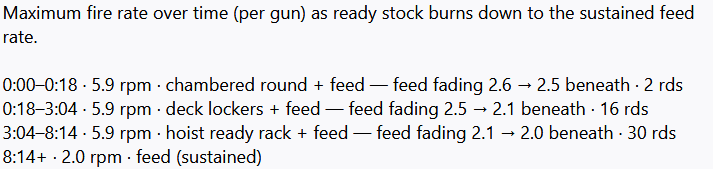
Full rate for the first eight minutes, each staged source going dry in turn - and then the human chain is the whole story. For a torpedo attack, fought and finished in minutes, that is enough. For anything longer, it is not, and the designer will not pretend otherwise.
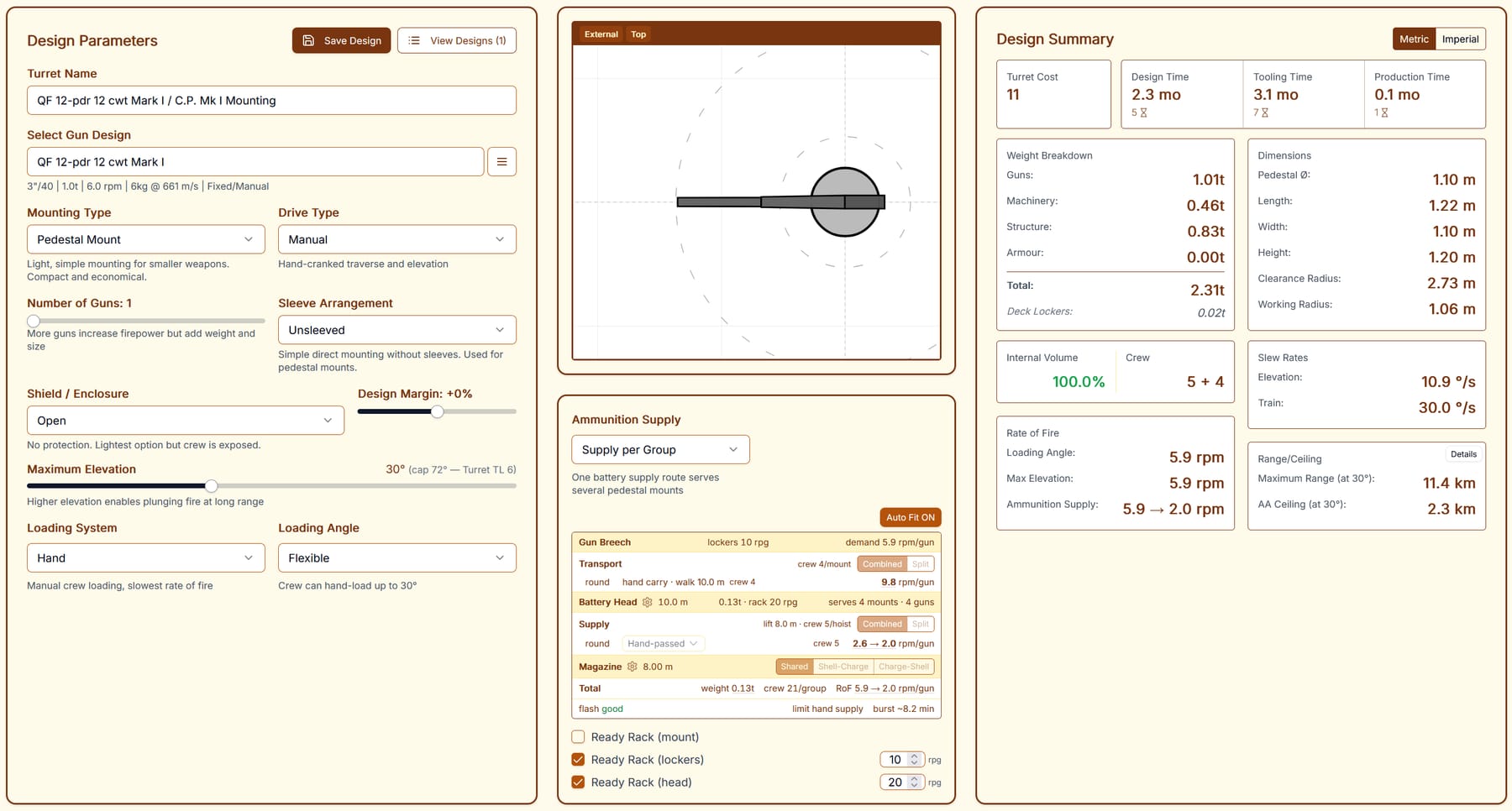
For the heavy guns, the supply chain is a detail you can balance away. For the quick-firers, it is the design - and every one of those staged rounds is ammunition sitting outside the magazine’s armour, which is its own conversation.
The chain so far
Notice what’s happening as we climb. The gun inherited your steel, your propellant, your tooling. The turret inherits the gun - its weight, its rhythm, its appetite. And the ship, when we get to it, will inherit the turret: the barbette diameter, the clearance arcs, the magazine spaces, the men who serve it.
gun → turret → ship → construction programme → fleet consequences.
Same chain as last time. One link further along.
All of it - the turret designer and the full ammunition-supply model, hoists and chains, working chambers and ready racks - is in the first free public build on 24 July.
And there is more here than one devlog can hold: the high-angle guns built to fight aircraft, where keeping the breech fed at full elevation becomes the whole problem, are a story for another day.
Closing
The Mark X has a house now.
It can see over the horizon. It can turn to face an enemy and hold him through the turn. Its shells arrive at the breech on time, in rhythm, from four decks down - and keep arriving for as long as the magazines hold out.
You forged the gun. You housed it. You armoured it. You fed it.
A gun became a weapon.
Next, the weapon needs a ship.